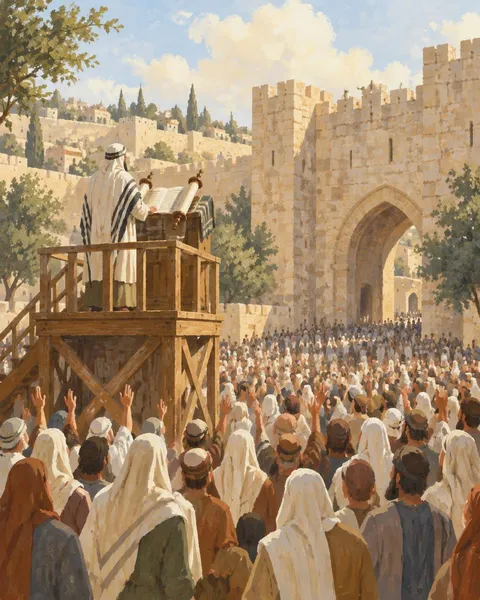
A royal cupbearer who left the palace to rebuild a broken city, and would not come down off the wall.
Grieving
Building
Frustrated
“I am doing a great work and I cannot come down.”
Go deeper
Introduction
Nehemiah had a secure job close to power. He was cupbearer to the king of Persia (Neh 1:11). When his brother brought news that Jerusalem's walls were still broken and its gates burned, he sat down and wept, and fasted and prayed for days (Neh 1:3-4).
Then he asked the king for leave, letters, and timber, and got them (Neh 2:4-8). He organized a whole city to rebuild, faced down mockery and threats, and finished the wall in fifty-two days (Neh 6:15). He was also blunt, quick to confront, and openly asked God to remember what he had done (Neh 5:19; 13:31). When he came back years later and found the people slipping, he was furious (Neh 13:6-25).
“
I am doing a great work and I cannot come down.
Name means
The LORD comforts
Home
Susa, Persia, then Jerusalem
Role
Cupbearer to King Artaxerxes, then governor of Judah
Read in
Nehemiah's story
Inspecting the ruins by night
Beginning
Weeps over the news
Comfortable in Susa, he hears Jerusalem lies in ruins. He mourns, fasts, and confesses his people's sin.
High point
Asks the king
Very much afraid, he prays silently and makes his request. The king grants it.
High point
Builds under threat
Enemies mock and plot. He sets guards, arms the builders, and tells them to remember the Lord.
High point
Defends the poor
He confronts the nobles for exploiting their own people and makes them return what they took.
High point
The wall is finished
Done in fifty-two days. Even their enemies see this work was done with the help of God.
Ending
Returns to find compromise
Back after time away, he finds old sins returning. He throws out Tobiah's goods, enforces the Sabbath, and rages at the men.
Starts as a comfortable cupbearer who weeps for a city. Ends as a tired reformer asking God to remember him for good (Neh 13:31).
Where Nehemiah lived and went
Only places Scripture records. Softer, dotted pins are traditional or uncertain sites. Tap a pin for the passage.
HomeMinistryKey momentTraditional or uncertainPinch or use + to zoom. Tap a cluster to spread it out.
How Nehemiah is wired
The Reformer
Enneagram 1, Helper wing
To set things right, to see God's city and people made whole and holy.
This one is debated. Here's why we land here.
At their best, toward 7 Under stress, toward 4
Why we think so
1
Order and plans. He surveyed the walls by night, then assigned each section to a family. ()
2
Zeal for what is right. He confronted the nobles, the priests, and the traders whenever God's law was being broken. ()
3
Wants to be found good. He repeatedly asked God to remember him for good. ()
The 2 wing shows in his care for ordinary people. He refused the governor's food allowance because the people were already burdened, and fed many at his own table. ()
The Enthusiast. At his best he leads the people into joy. At the dedication of the wall the joy of Jerusalem was heard far away. ()
The Individualist. Under strain he turns inward and wounded. His repeated pleas that God remember him read like a man who feels his work slipping away and unseen. ()
The case for 8
Many read him as a Challenger. He takes charge, faces enemies head on, refuses to be intimidated, and responds to wrongdoing with force ().
Other lenses
Big Five. Read from what is recorded in the books of the exile and return.
ReservedOutgoing
SteadyReactive
ChallengingAccommodating
SpontaneousDisciplined
TraditionalCurious
DISC style: Driven, organized, unbending
Strengths & struggles
What's good in Nehemiah
Prayerful action. Planning and leadership. Courage under threat. Generous with his own money and food (). Defended the poor against the rich ().
Where Nehemiah struggles
Harsh in anger. He cursed and beat some of the men and pulled out their hair (). His reforms depended on his presence, and slipped while he was away ().
What Nehemiah wanted most
A restored Jerusalem and a holy people, and to be remembered by God for good ().
What Nehemiah feared most
Disgrace for God's city and people, and the work stopping ().
Nehemiah's people
The Lord
The LORDNehemiah prayed to the God of heaven before and during everything he did ().
Family
HananiHis brother, who brought the news from Jerusalem and was later put in charge of the city ().
Friends
ArtaxerxesThe Persian king he served, who granted his request and sent him with letters and an escort ().
EzraThe priest and scribe who read the Law while Nehemiah served as governor ().
Tension
EliashibThe priest who gave Tobiah that room while Nehemiah was away ().
Opposed
SanballatA regional official who mocked, threatened, and schemed to stop the work ().
TobiahAn ally of Sanballat who later got a room in the temple courts ().
Family of Faith
See where Nehemiah fits
AbrahamJesus
c. 480–410 BC. Connected to Jesus through Malachi → John the Baptist.
Nehemiah left the palace to rebuild a ruined city, and his unfinished reforms point to a better builder.
Nehemiah gave up comfort to restore God's people, and the work was real but did not last. The people slid back as soon as he left (). That points to Christ, who left far more than a palace, who builds a people from the inside, and who brings the lasting city Abraham waited for, “the city that has foundations, whose designer and builder is God” ().
Questions to sit with
1
Nehemiah prayed in the moment before he spoke to the king. What would it look like to pray that way in your work?
2
His reforms faded when he left. Where are you relying on your own effort to hold things together?
Study Nehemiah with your group
Ready-to-lead group studies with discussion questions and a leader's note are on the way.