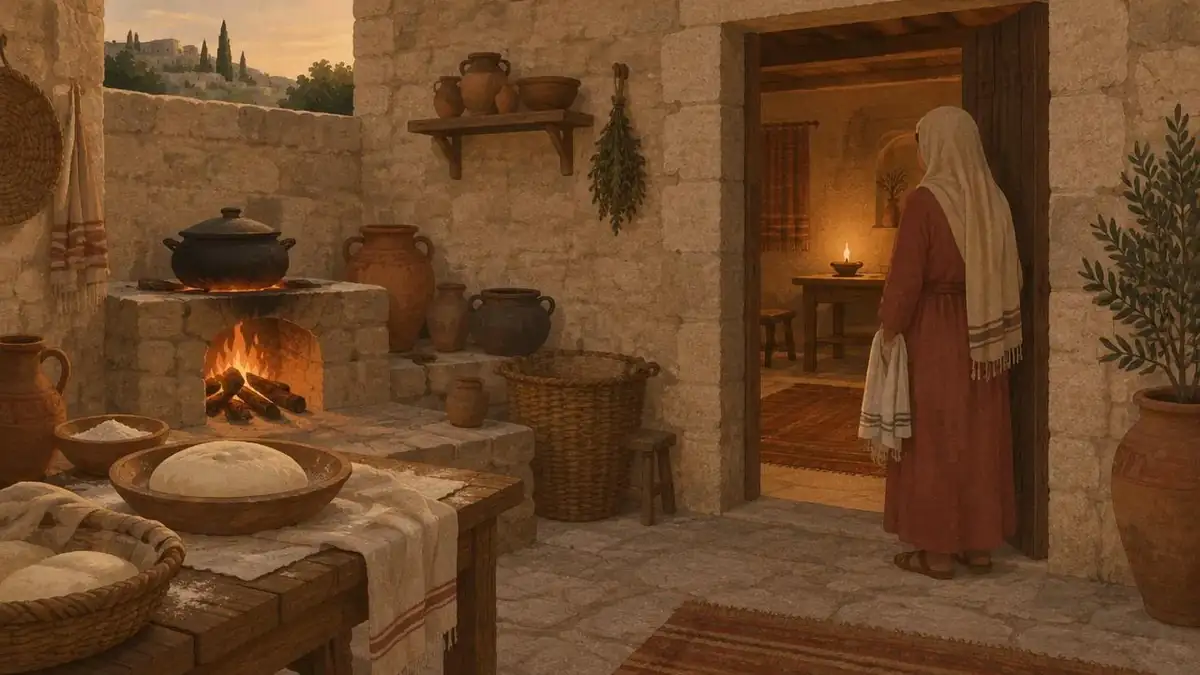
Martha opened her home to Jesus and his disciples, and then she got busy. While her sister sat and listened, Martha worked. Eventually she asked Jesus to tell Mary to help. He answered her gently, by name, twice.
That is often all people remember. But John tells us Jesus loved Martha. When her brother died, she went out to meet Jesus on the road. In her grief she made one of the clearest confessions of faith in the Gospels.
“
Yes, Lord; I believe that you are the Christ, the Son of God, who is coming into the world.
Name means
“Lady” or “mistress of the house” (Aramaic)
Home
Bethany, about two miles from Jerusalem
Role
Host, friend of Jesus, sister of Mary and Lazarus
Read in
; ;
Martha's story
Anxious and troubled
Beginning
Opens her home
Martha welcomes Jesus and his disciples into her house.
Turning point
Anxious and troubled
Distracted by serving, she asks Jesus to send Mary to help. He tells her only one thing is necessary.
High point
Meeting him on the road
Lazarus is dead. She tells Jesus he could have prevented it, then confesses him as the Christ, the Son of God.
Turning point
The stone and the smell
At the tomb she objects that Lazarus has been dead four days. Jesus reminds her that if she believes, she will see the glory of God.
Ending
Martha served
At a dinner after Lazarus is raised, she serves again. Scripture records no complaint this time.
Starts as a capable host who felt left to do it all. Ends as a believer who served in the presence of her risen brother.
Where Martha lived and went
Only places Scripture records. Softer, dotted pins are traditional or uncertain sites. Tap a pin for the passage.
HomeMinistryKey momentTraditional or uncertainPinch or use + to zoom. Tap a cluster to spread it out.
Martha appears only in Bethany.
How Martha is wired
The Reformer
Enneagram 1, Helper wing
To do what is right and see that things are done properly.
This one is debated. Here's why we land here.
At their best, toward 7 Under stress, toward 4
Why we think so
1
A sense of fairness. She names the imbalance plainly: her sister has left her to serve alone. ()
2
Practical realism. At the tomb she points out what is true on the ground, that the body has been dead four days. ()
3
Moves to act. When she hears Jesus is coming, she gets up and goes out to him while Mary stays home. ()
Her default way of loving is to host and serve. ()
The Enthusiast. At the dinner in Bethany she serves among friends and her living brother, and no complaint is recorded. ()
The Individualist. She feels unseen and alone. Her question to Jesus is whether he cares at all. ()
The case for 2
Hospitality is her signature, and her frustration in could be the hurt of a helper whose service goes unnoticed rather than a reformer's sense of order.
Other lenses
Big Five. Read from what she says and does in the Gospels.
ReservedOutgoing
SteadyReactive
ChallengingAccommodating
SpontaneousDisciplined
TraditionalCurious
DISC style: Capable, direct, gets it done.
Strengths & struggles
What's good in Martha
Hospitality. Initiative. Directness with Jesus. Practical sense.
Where Martha struggles
She could let the work crowd out the Lord she was working for (). Her realism sometimes got ahead of her faith ().
What Martha wanted most
To do things right and to see things set right, including her brother's life (; ).
What Martha feared most
Being left alone with the load, and that Jesus did not care ().
The answer to Martha's grief was not a doctrine but a person.
Martha already believed in a resurrection on the last day. Jesus told her the resurrection was standing in front of her: “I am the resurrection and the life. Whoever believes in me, though he die, yet shall he live” (). Then he proved it at her brother's tomb.
Questions to sit with
1
What are you anxious and troubled about that is crowding out the one necessary thing?
2
When have you been honest with Jesus about your disappointment, and what did you learn about him?
Study Martha with your group
Ready-to-lead group studies with discussion questions and a leader's note are on the way.